A few days ago, I blogged about how I had perfectionist parents but I did not reveal how low self-esteem has always been such a great challenge in my life. In fact, I believe that it could be the root of many issues and challenges that many of us may face in life.
In many ways, I regard it as a very insidious problem that must be dealt with lest it causes other more serious problems. Many do not regard the problem as a serious one when actually it is. Some prefer to partake in the blame game by blaming others for their plight. Now when they do this, they become more detached from the problem and ultimately deprive themselves of confronting and dealing with the real problem and moving even further away from the solution. When this happens, history repeats itself and the person is forced to relive the nightmare all because of low self-esteem.
As one who used to be a drama queen, now I realize that I am not the worst in life and others have gone through similar problems like I have either at a worse or lesser level and have survived and so will I. Ultimately, it is all up to us to live with a healthy level of self-esteem.
Some may feel that this problem does not concern them but actually, no matter how confident one may be, self-esteem problems may still exist albeit at a subtle level. On a personal level, I confess that the failure for me to reach out for my dream, for something I loved greatly when I was young, and the way in which I settled for a safe route to a boring sedate existence damaged the way I looked at myself. Basically, my self esteem issues were inherited from my parents, at a very early stage because of the way I was brought up. My mother, whom I love very much, pushed me to excel and her way of doing it was by putting me down via reverse psychology, completely unaware of its ill-effects on my development. While parents are primarily responsible for shaping our young psyches at this time, the other agents of socialization such as schools, peer and the media also play an important role. Thus, our later experiences in life merely reinforce the core impressions we gained at a very early age.
Older and wiser, I realize more than ever that the role of parents is so vital, and we have to be very conscious that EVERYTHING we do, say, or even think, can have consequences for our children. Moreover, this care must begin whilst the child is still in the womb! If we are too relaxed about how we bring them up, we may unconsciously pass on our own limitations to them as a result.
To overcome low self-esteem, I believe that the first thing is to differentiate self-esteem from self-image. Self-image is developed when we make comparisons between ourselves and those around us and then to judge the image we have of ourselves which is sadly, often negative. And why so? If we look around us, we can usually find someone better than us at almost everything. Once developed, self-image affects self-esteem. Take a look at young children. Isn't it wonderful to see how they seem to have perfect self-esteem BECAUSE they have no self-image? They are NOT continually judging themselves against externals and falling short.
Well, to be honest, it was very tough for me when I was young. From day 1 in Std 1, I was in a very competitive environment in the top class and amongst the top. Then I skipped a year of school and had a double promotion from Year 3 to Year 5 and we were pushed because we were in the express class system (which is why when my older boy qualified for the PTS and could skip a year as well, I put my foot down firmly and refused to let him jump...now he realizes the wisdom of my objection). It did not help that I was surrounded by brain boxes - my classmates were really brainy and there were six who eventually became doctors, gynaecologists, one became a professor at Harvard and others who made inroads in research not forgetting many chartered accountants. And me? Humble me is just me :-). I excelled in university only because my childhood classmates were no longer with me and I fought on new battle ground and surprised myself by graduating top of the class. Sadly, I missed first class honors by a hair's breath and it was only many years later that I realized the implication of being summoned to the Dean's office to explain why I missed first class honors. Yup - I blew that opportunity because I thought I was not good enough. Er...I still have such feelings but I deal with it whenever it emerges, such as by writing this post to exorcise old ghosts in my life :-).
After going through so much in life, after so many ups and downs, mountain-top and valley deep experiences, I know that the key is NOT to work upon self-image. Unfortunately, this is what many people try to do. Deep in my heart, I know that working on self-esteem is the key to creating radical change because as we work from the inside out, how we feel about ourselves in comparison with externals can eventually improve as well.
A lot depends on how we control our self-talk. If we partake in negative self-talk, naturally negative self esteem will be developed. The things we say to ourselves in our minds, as well as the way in which we interpret events in our lives would define the reality in which we live. Most people practise negative self-talk because they see the worst in themselves and in everything that happens. I have been blessed by good friends who have, at different stages of my life, exhorted me to put a stop to such self-destructive thinking. It is our thoughts and expectations that shape and produce what we become and ultimately, the quality of our lives would then be a direct consequence.
To overcome negative self-talk, we can use positive affirmations to nullify negative thoughts. As these two contradictory ideas battle out in our brain, eventually one will prevail and the other will collapse as a consequence. And the one in which we invest the greatest energy and frequency of thought will be the one that wins - the one that leads us to greater self-esteem.
In my personal battle with low self-esteem, I have discovered that there are many effective ways to develop a healthy level of self esteem and the first step in that direction is recognition of the existence of the problem and to take total responsibility for dealing with it. It takes a lot of effort and commitment to develop ourselves in the right direction and the support plus understanding of our loved ones matter a lot. Look out life - I am moving in the direction of creating a higher level of self-esteem and I hope you are too!
Have a great day!
...this is probably why...
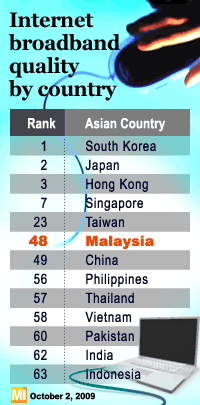 Yes, a new study by Oxford University, in collaboration with Cisco, has rated us a not-too-great #48 in terms of broadband quality, as reported by The Malaysian Insider today.
What the report does is officially documenting something Malaysian Internet users are already painfully aware of – that our broadband isn’t all that broad.
Walski urges you to take some time to look at the actual report, which can be viewed here (via the Oxford Said Business School website).
Malaysia’s relatively low ranking, among the countries included in the study, may be telling in itself. But it doesn’t tell the whole story – which, unfortunately, is sadder than simply the ranking.
While the emphasis area that we keep hearing from the government is penetration, i.e. the percentage of households with broadband access, the Broadband Quality isn’t simply about how many people have access to services.
There is, in fact a lot more to Broadband Quality – like data throughput and latency – something that many Internet users in Malaysia can tell you is definitely not up to snuff.
(factors in the study, and more, in the full post)
The main focus of the study, from what Walski gathers, is how broadband services worldwide are coping with the applications being accessed today, and how future ready they are on the demands of the future.
And it is this area that Malaysia fares not very well, ranking in the region of “Below today’s application threshold”.
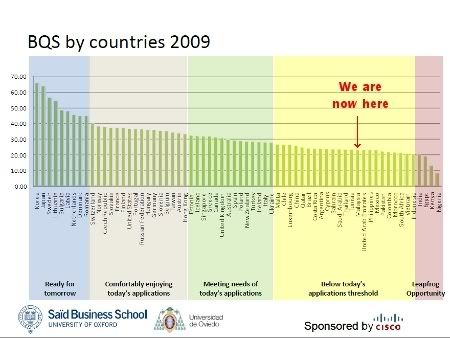
Compared to last year’s inaugural study, we have improved. However, the parameters governing the measurements have also changed, namely the threshold values determining adequacy for now, and for the future.
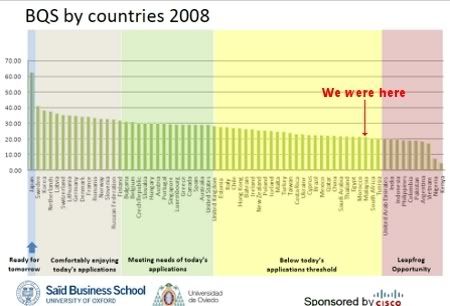
In essence, the report uses the following main broadband quality parameters (derived from the report, downloadable from here):
- Download throughput – the net bitrate of downstream data. This criterion is important for effective streaming of high quality video and sharing of large files (increasingly important in collaborative across the ‘Net endeavors)
- Upload throughput – the net bitrate of upstream data. This criterion plays an important part in sharing and uploading of image/video, and 2-way high quality video communications
- Latency – time taken for data packets to travel from source to destination. This criteria is important for real-time applications, such as Voice over IP (VoIP)
- Other criteria taken into consideration include network oversubscription, data packet loss, jitter (measure of latency variation over time), service continuity, etc.
In other words, the report looks at much more than just penetration. One factor that has been introduced into the 2009 report is the disparity of Broadband Quality Score (BQS) between urban and non-urban areas within a given country. This is one area where Malaysia scores rather low – meaning that there is not much of discernible difference of quality between urban and non-urban areas. Which is still not a good thing, because what it implies is that the quality is pretty low throughout.
Some apologists might view this report, particularly when it comes to Malaysia’s placing, as the West trying to undermine our country’s efforts in IT proliferation. If one were to actually read the report, however, it can easily be ascertained that this is definitely not the case. In fact, 4 out of the top 10 countries on the list are in Asia, with the top 3 being South Korea, Japan and Hong Kong (in order of ranking).
There is also an implicit link between broadband quality and the economic focus of a given country. If Malaysia wants to transition towards becoming a more high-value, technologically driven economy, the availability of a world-class communications infrastructure becomes an important factor. Apart, of course, from a world-class education system – another area where much is left to be desired.
The question on the minds of many Malaysians, Walski included is this: how is it that Malaysia has fared so badly despite the fact that the MSC (Multimedia Super Corridor), launched in 1986, was supposed to propel Malaysia prominently into the world of IT? 13 years later, we’re still talking about broadband penetration (currently at around 26% or thereabouts) as being the key benchmark, and not about other more important factors, such as quality of service.
Apart from a quantitative analysis, the report also provides some broad recommendations to countries in how improvements can be realized. Some of these recommendations include (emphasis by myAsylum):
- Set national broadband agenda with goals for availability, penetration and quality.
- Provide content and applications that are quality-aware to ensure a consistent customer experience
- Build a broadband business model based on quality as the key differentiator
Any Malaysian broadband user that has used similar services abroad will immediately realize that something is amiss with the level of quality provided within Malaysia. It is, in fact, glaringly obvious sometimes, as Walski has discovered. “Best Effort” is simply no longer good enough a promise that an increasingly globally-aware Malaysian population will put up with.
What he wonders, though, is if the right criteria are being looked at, as we strive for improvement. So far, it seems that penetration, and penetration alone, is the focus, implying that if our target is met (50% by 2010), we’ll still be playing catch-up in other, more critical areas.
written by Walski at THIS LINK.*reblogged with permission from Walski. Thanks, Walski.