In the 1960's, we did not have the luxury of shopping malls, Coffee Bean, Starbucks or San Francisco Coffee. Neither did we have Old Town Cafe or upbeat modern day kopi tiam outlets.
We only had kopi tiams.
Kopi tiams with jukeboxes.
*Kopi tiams are Malaysian coffee shops that mushroomed in the 1950's and became part of Malaysian culture. These featured round marble tables with wooden chairs and an array of drinks and hawker fare are sold in these shops. Today, more prefer to go to hawker centres although tourists still flock to famous kopi tiams that sell the usual 'char kuay teow', 'hokkien mee' and other local delights.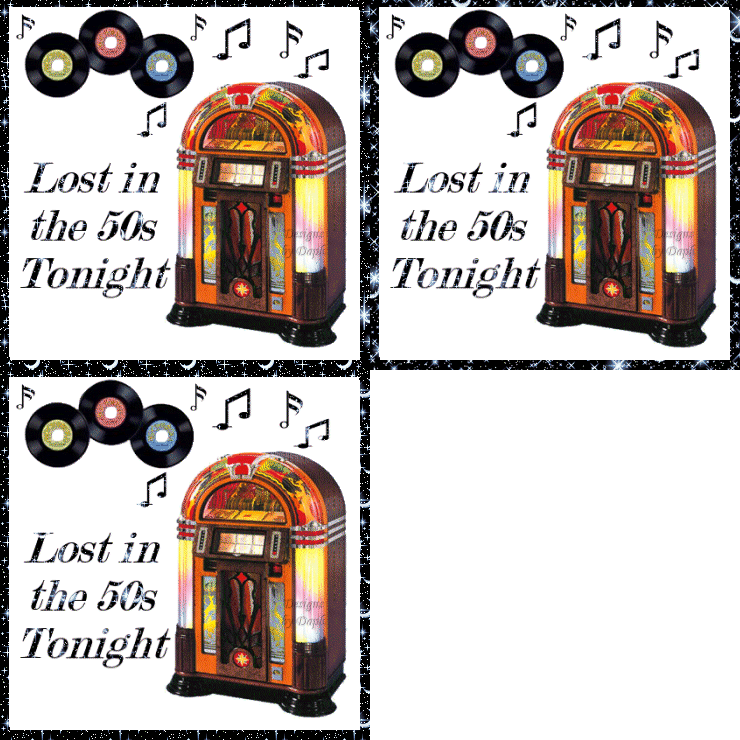
I remember a few coffee shops in Penang that had jukeboxes including Keat Seng Coffee Shop along Penang Road. It was a real treat to be able to go there on Saturday afternoons. The kopi tiam had a groundnut dispensing machine. For ten cents, one could press this lever and this machine would spit out peanuts on one's hand.
Coming back to the story, I cannot imagine what my childhood would have been like without jukeboxes. With a twenty cent coin, I could listen to One Way Ticket or La Bamba and other tunes by the Shirelles, Neil Sedaka, Perry Como and others. Of course, my parents and relatives were not happy that my cousins and I would use our pocket money for the jukebox tunes as 20 cents was a lot of money in those days. In fact, one could buy a bowl of Hokkien Mee (with extra condiments, mind you!) with a twenty cent coin.
The greatest tragedy was the agony of waiting for my song to be played after excitement of slotting the coin, selecting the song, pressing the alphabet and the number for the song. And why? Others could have actually put in lots of coins before me!!! By the time my song was played, we had already left the coffee shop and my heart was broken! Money wasted, song also not heard...
For me, I reckon the most memorable part was seeing the machine select the cord from the folder and how the mechanical hand would place it slowly but surely on the turn-table - absolutely fascinating! For a more technical description of how it works, please CLICK HERE.
My dear friend Angela shared with me her unforgettable moments in front of the jukebox and how she moved to the beat of the music with her girlfriends when they hung out at Keat Seng too!!! According to Angela, she would out (in Hokkien it is called loke poe) with her girlfriends by taking the bus to town and making eyes at the boys there :-). Those were the days, my friend, when courtship was a complicated affair of many stages. Those were really the lazy, crazy, hazy days of youth spent in front of the jukebox.
In fact, many movie scenes of old time favorites revolved round jukeboxes. The typical stereotype was of the GI's falling in love with pretty girls while waiting to make their selections at jukeboxes. It was quite common for young people to dance around the jukebox. Perhaps some of you may remember "Happy Days" or even "Grease" which had such scenes.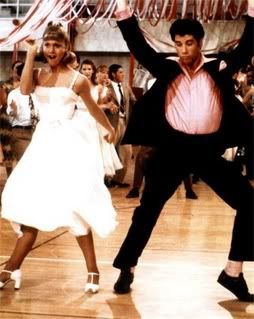
For the younger readers out there who may not have had unforgettable moments with the jukebox, here's a litle bit of history, thanks to Wikipedia.
A jukebox is a partially automated music-playing device, usually a coin-operated machine, that can play specially selected songs from self-contained media. The traditional jukebox is rather large with a rounded top and has colored lighting on the front of the machine on its vertical sides. The classic jukebox has buttons with letters and numbers on them that, when combined, are used to indicate a specific song from a particular record.
Coin-operated music boxes and player pianos were the first forms of automated coin-operated musical devices. These were soon followed in the 1890s by coin-operated phonographs.[1][2] The introduction of recording on wax cylinder records made possible records which could survive many plays, and early operators converted cylinder phonographs to accept a coin, usually a nickel, which unlocked the mechainsm, allowing the listener to turn a crank which simultaneously wound the spring motor and placed the reproducer's stylus in the starting groove. Frequently exhibitors would equip many of these machines with listening tubes (acoustic headphones) and array them in "phonograph parlors" allowing the patron to select between multiple records, each played on its own machine. Some machines even contained carousels and other mechinisms for playing multiple records. However, by the early 1900s the novelty of the phongraph wore off and this, combined with the advent of phonographs in the home, as well as the increasing sophistication and volume of mechanical orchestrions in public facilities, led to the decline of the coin-operated phonograph industry.
The advent of electrical recording and amplification lead to a resurgence of the coin-operated phonograph.
One of the first successful selective jukeboxes was an automatic phonograph produced in 1927 by the Automated Musical Instrument Company, later known as AMI. With the passage of time the and development of technology new products are manufactured and consequently in 1928, Justus P. Seepburg, who manufactured player pianos, created an electrostatic loudspeaker combined with a record player that was coin operated and gave the listener a choice of eight records.[3] The shellac 78 rpm record dominated jukeboxes until the Seeburg Corporation introduced an all 45 rpm vinyl record jukebox in 1950.
The term "juke box" came into use in the United States around 1940, apparently derived from the familiar usage "juke joint", derived from the Gullah word "juke" or "joog" meaning disorderly, rowdy, or wicked. This term, like thousands of words in the Gullah language, likely originated in Western Africa near Sierra Leone[4] and is akin to the Wolof dzug and Bambara dzugu[5].
Wallboxes were an important, and profitable, part of any jukebox installation. Basically a remote control, they enabled patrons to select tunes from their table or booth. The most famous is the Seeburg 3W1, introduced in 1949 as companion to the new 100-select Model M100A jukebox. Stereo sound became popular in the early 1960s, and wallboxes of the era were designed with built-in speakers to provide patrons a sample of this latest technology. Interestingly, for the next several years, there were very few stereo 45 rpm records made; the "little LP" (also referred to as "stereo 7") was designed and manufactured specifically for jukeboxes. It played at 33 1/3 rpm and was the same physical size as the 45 rpm records, to retain compatibility with the jukebox mechanisms.
Some jukeboxes during this time were able to play other special 33 discs of 45 size, which provide a longer song or multiple songs, for a higher price. These specialty records (known as EPs, for "extended play") were provided by the unique vendor that supplied records to the operator. Those decades also produced models with ornate lighting, disco and psychedelic effects, and other cosmetic improvements while the internal mechanisms remained moderately stable by comparison. Song-popularity counters told the operator the number of times each record was played (A and B side were generally not distinguished), with the result that popular records remained, while lesser-played songs were replaced with the latest hits.
Jukeboxes and their ancestors were a very profitable industry from the 1890s on. They were most popular from the 1940s through the mid-1960s, particularly during the 1950s. Today they are often associated with early rock and roll music, but were very popular in the swing music era as well. As a result, stores and restaurants with a retro theme, such as the Johnny Rockets chain, include jukeboxes.
Starting in the 1980s, compact discs became the norm for modern jukeboxes. Towards the end of the 20th century several companies started introducing completely digital jukeboxes which did not use physical recordings. The music selection and playback system was replaced by a dedicated proprietary computer. A selection of songs suitable to the venue where the jukebox is located are generally cached in the local storage of the machine. The true advantage of this design is the seemingly endless selection of music available instantly to the customer by automatic download from an internet connection.


To read the rest of the entry, please CLICK THIS LINK.
For those of you who grew up with jukeboxes, may you be flooded with memories of happy times around jukeboxes as you reminisce ...
To have the right mood, perhaps you might want to try the following websites.
1. Upchucky
2. Beatles Tube
Do leave a comment if you wish. Thanks.
Have a lovely evening, dear reader!