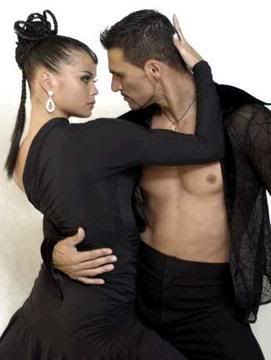
Years ago when my older boy was in Std. 2, my husband and I took up ballroom dancing. Serious! We learnt the waltz, tango, foxtrot, nightclub two-step and also Latin American dances such as cha-cha-cha , rhumba, merengue, favorite jive and the east coast swing. My late father was a ballroom dance enthusiast and used to give lessons as well. However, he never really taught us because he figured there was not much hope for my husband and I ;-p.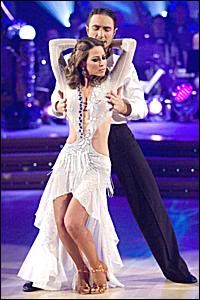
Last night, I was listening to one of my favorite tunes - Antonio Banderas' version of Beautiful Maria of My Soul from the movie "The Mambo Kings" based on the book of the same name written by Oscar Hijuelos who is the first Hispanic to win the Pulitzer Prize for fiction. I met him a few years ago at a writers' conference and just could not believe then that a famous writer such as he could be so down to earth and humble.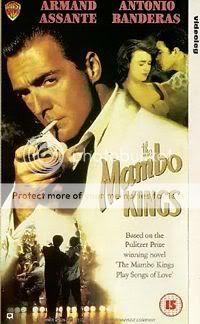
The Mambo Kings tells the story of César and Nestor Castillo, brothers and aspiring musicians who flee from Cuba to America in search of the American Dream. According to Wikipedia HERE, the film received an Academy Award Best Original Song nomination for its original song, Beautiful Maria of My Soul, which was also nominated for a Golden Globe Award in the same category. The film's song was also nominated for the Grammy Awards' "Best Song Written Specifically for a Motion Picture or for Television" category, along with a second number from the soundtrack, Mambo Caliente. Latin music legends Celia Cruz, Tito Puente and Arturo Sandoval performed on the soundtrack album.
CLICK HERE to listen to the song which is a beautiful piece, sung with so much passion and most seductively in a deep throaty velvety voice by Antonio Banderas! This movie shot him to stardom years ago and if you still have not watched The Mambo Kings, please do so asap!!
Anyway, listening to that song over and over again yesterday and even this afternoon while shopping for blogger templates (yup - time to change templates soon), I remembered those days when hubby and I were dancing away at different places. Some may think it is a romantic pursuit but dancing is akin to a marriage. How and why? You can read my thoughts about this topic in an old post called Do You Jive, Quickstep or Salsa?
Dancing requires discipline, patience, stamina, perseverance and the willingness to learn from mistakes, much like being a spouse to the one to whom we married.
I've forgotten many of my rhumba steps and was happy to discover a few good video clips that actually refreshed my memory.
So if you are interested in the basics of rhumba, please CLICK HERE.
If you prefer cha-cha-cha, please CLICK HERE.
If you rather learn the sexy merengue, then CLICK HERE.
And of course if you like the lively and seductive salsa, CLICK HERE.
My aunt in US is almost over 75 years old and still dances almost everyday. She looks younger, sexier and has a svelte body like that of a 40 year old!!! Even at her age, she goes to Blackpool Dance Festival every year to compete. She has always reminded me that when dancing, we must enjoy ourselves and NOT to be self-conscious.
At the same time, she always advised me to let my hair down and to just groove with the music. However, hand, hip movements, posture and even facial expressions are very important to project the right mood and to show that we are having the time of our lives.
If you are not attending the vigil tonight, I hope this post can make you dance the night away! Do share your thoughts and experiences about dancing. Thanks! Have a lovely evening!
When you looked at my blog title, did you think of the song by Don Mclean called "American Pie" which was recorded and released on the "American Pie" album in 1971? For four weeks, the single was a number-one U.S. hit. A re-release in 1991 did not chart in the U.S., but reached number 12 in the UK.

Please CLICK HERE for a youtube version of the song with lyrics or CLICK HERE to watch him perform LIVE. The second version has many improvised parts which some may enjoy..
Dear reader, that song was one of my favourite songs during my primary schooldays. I recall many occasions when I sang this song while in secondary school and imagined I was a Malaysian version of Don Mclean while strumming my box guitar. I listened to this song over and over again to catch his style and put in more work practising than I did for my school work! It was only recently, however, that I discovered that the song is an abstract story surrounding "The Day the Music Died" — the 1959 plane crash that killed Buddy Holly, Ritchie Valens and The Big Bopper (Jiles Perry Richardson, Jr.)!!!! As a little girl then, I often wondered what he was referring to and my highly imaginative mind then came up with a few theories including a beauty queen, a new type of dish etc.
The importance of "American Pie" to America's musical and cultural heritage was recognized by the Songs of the Century education project which listed the song as the number five song of the twentieth century. Some Top 40 stations initially played only side two of the single, but the song's popularity eventually forced stations to play the entire piece. Many would know that this song is VERY long and if truth be told, I confess I have never managed to memorize the entire song!
Actually, I only found out the background of this song when I was doing research on Richie Valens "OH DONNA" which I used to sing when I was in kindergarten as my dad would play this song over and over in the evenings...I will be doing a separate post on Richie Valens very soon. Originally, I wanted to write about Richie Valens first because my heart broke when I discovered that he died 8 months after he achieved fame with "OH DONNA" and "LA BAMBA" at the tender age of 17!!! I thought to myself what a difference it would have made to pop history if the three of them - Richie Valens, Buddy Holly and The Big Bopper!!! Perhaps The Beatles and others might not have achieved as much popularity for Valens, Holly and Richardson had a different type of music from other artistes of their time! Then the truth of that line "The day the music died' dawned on me upon the realization of these facts. The more I read, the more I felt convicted that I would have to devote a whole post to this song. Thankfully, my older boy and his girlfriend also studied all this in their Pop History course in university so I could actually discuss this with them. Actually, I know I would thoroughly enjoy pursuing a degree in contemporary music.
(Aside: Would you believe me if I told you that while writing this post, I was singing American Pie while listening to the different versions available in youtube? Gosh - I wish they had youtube when i was young...maybe I would have ended up in the music industry! (*dreaming haha*) To date, only one of my compositions has been recorded but then, it is because it has been three years since I wrote any piece...sorry for the digression...)
By far, the following website OVER HERE has the best background information on this song. And if you are interested, THIS LINK will lead you to the official website of Don Mclean and American Pie.
The following section, which I believe offers an excellent explanation of the song, is taken from THIS LINK which is maintained by Rich Kulawiec. Perhaps after reading this post, "AMERICAN PIE" will hold more meaning for you, dear reader. It did for me...and it made me appreciate the fact that Mclean is not only a fantastic singer and guitarist but that he is also a brillaint song writer!!! Original lyrics are in blue.

AMERICAN PIE by Don McLean
The entire song is a tribute to Buddy Holly and a commentary on how rock and roll changed in the years since his death. McLean seems to be lamenting the lack of "danceable" music in rock and roll and (in part) attributing that lack to the absence of Buddy Holly et. al.
(Verse 1)
A long, long time ago...
"American Pie" reached #1 in the US in 1972, but the album containing it was released in 1971. Buddy Holly et.al. died in 1959.
I can still remember how
That music used to make me smile.
And I knew if I had my chance,
That I could make those people dance,
And maybe they'd be happy for a while.
One of early rock and roll's functions was to provide dance music for various social events. McLean recalls his desire to become a musician playing that sort of music.
But February made me shiver,
Buddy Holly died on the night of February 2, 1959 in a plane crash in Iowa during a snowstorm. The news came to most of the world on the morning of February 3, which is why it's known as The Day The Music Died.
With every paper I'd deliver,
Don McLean's only job besides being a full-time singer-songwriter was being a paperboy.
Bad news on the doorstep...
I couldn't take one more step.
I can't remember if I cried
When I read about his widowed bride
Holly's recent bride was pregnant when the crash took place; she had a miscarriage shortly afterward.
But something touched me deep inside,
The day the music died.
The same plane crash that killed Buddy Holly also took the lives of Richie Valens ("La Bamba") and The Big Bopper ("Chantilly Lace"). Since all three were so prominent at the time, February 3, 1959 became known as "The Day The Music Died".
So...
(Refrain)
Bye bye Miss American Pie,
Miss American Pie *is* rock and roll music. Don McLean dated a Miss America candidate during the pageant. (unconfirmed)
Drove my Chevy to the levee but the levee was dry
Them good ol' boys were drinkin whiskey and rye
Singing "This'll be the day that I die,
This'll be the day that I die."
One of Holly's hits was "That'll be the Day"; the chorus contains the line "That'll be the day
(Verse 2)
Did you write the book of love,
"The Book of Love" by the Monotones; hit in 1958.
And do you have faith in God above,
If the Bible tells you so?
In 1955, Don Cornell did a song entitled "The Bible Tells Me So". Rick Schubert pointed this out, and mentioned that he hadn't heard the song, so it was kinda difficult to tell if it was what McLean was referencing. Dave Tutelman tells me that this particular song wasn't exactly a gem of rock 'n roll.
There's also an old Sunday School song which goes: "Jesus loves me this I know, for the Bible tells me so" (Stephen Joseph Smith tells me that Bartlett's gives the source of this as "The Love of Jesus", by Anna Bartlett Warner, 1858.)
Now do you believe in rock 'n roll?
The Lovin' Spoonful had a hit in 1965 with John Sebastian's "Do you Believe in Magic?". The song has the lines:
"Do you believe in magic" and
"It's like trying to tell a stranger 'bout rock and roll."
Can music save your mortal soul?
And can you teach me how to dance real slow?
Dancing slow was an important part of early rock and roll dance events -- but declined in importance through the 60's as things like psychedelia and the 10-minute guitar solo gained prominence.
Well I know you're in love with him
'Cause I saw you dancing in the gym
Slowdancing COULD just be dancing, or it could be vertical "making out". It wasn't hard to watch a couple slow-dancing and figure out whether they had some sort of relationship, if you knew anything about slow dancing. So just the fact they were dancing didn't tell you anything, but if "I saw you dancing in the gym" I could tell from watching whether there was anything between you (figuratively :-). (Thanks to Dave Tutelman for this note.)
You both kicked off your shoes
A reference to the beloved "sock hop". (Leather-soled street shoes tear up wooden basketball floors, and rubber-soled sneakers grip too much for dance moves, so dancers had to take off their shoes.)
Man, I dig those rhythm 'n' blues
Some history. Before the popularity of rock and roll, music, like much else in the U. S., was highly segregated. The popular music of black performers for largely black audiences was first called
"race music", later softened to rhythm and blues. In the early 50s, as they were exposed to it through radio personalities such as Allan Freed, white teenagers began listening, too. Starting around 1954, a number of songs from the rhythm and blues charts began appearing on the overall popular charts as well, but usually in cover versions by established white artists, (e. g. "Shake Rattle and Roll", Joe Turner, covered by Bill Haley; "Sh-Boom", the Chords, covered by the Crew-Cuts; "Sincerely", the Moonglows, covered by the Mc Guire Sisters; Tweedle Dee, LaVerne Baker, covered by Georgia Gibbs). By 1955, some of the rhythm and blues artists, like Fats Domino and Little Richard were able to get records on the overall pop charts. In 1956 Sun records added elements of country and western to produce the kind of rock and roll tradition
that produced Buddy Holly. (Thanks to Barry Schlesinger for this historical note. ---Rsk) (Oh...and Barry, Dave Tutelman wants to know if you were Bronx Science class of '58.)
I was a lonely teenage broncin' buck
With a pink carnation and a pickup truck
"A White Sport Coat (And a Pink Carnation)", was a hit for Marty Robbins in 1957. The pickup truck has endured as a symbol of sexual independence and potency, especially in a Texas context. (Also, Jimmy Buffet does a song about "a white sport coat and a pink crustacean". :-) )
But I knew that I was out of luck
The day the music died
I started singing...
Refrain
(Verse 3)
Now for ten years we've been on our own
McLean was writing this song in the late 60's, about ten years after the crash.
And moss grows fat on a rolling stone
It's unclear who the "rolling stone" is supposed to be. It could be Dylan, since "Like a Rolling Stone" (1965) was his first major hit; and since he was busy writing songs extolling the virtues of simple love, family and contentment while staying at home (he didn't tour from '66 to '74) and raking in the royalties. This was quite a change from the earlier, angrier Dylan.
The "rolling stone" could also be Elvis, although I don't think he'd started to pork out by the late sixties.
It could refer to rock and rollers in general, and the changes that had taken place in the business in the 60's, especially the huge amounts of cash some of them were beginning to make, and the
relative stagnation that entered the music at the same time. Or, perhaps it's a reference to the stagnation in rock and roll.
Or, finally, it could refer to the Rolling Stones themselves; a lot of musicians were angry at the Stones for "selling out". Howard Landman points out that John Foxx of Ultravox was sufficiently
miffed to write a song titled "Life At Rainbow's End (For All The Tax Exiles On Main Street)". The Stones at one point became citizens of some other country merely to save taxes.
But that's not how it used to be
When the jester sang for the King and Queen
The jester is Bob Dylan, as will become clear later. There are several interpretations of king and queen: some think that Elvis Presley is the king, which seems pretty obvious. The queen is said to be either Connie Francis or Little Richard. But see the next note.
An alternate interpretation is that this refers to the Kennedys -- the king and queen of "Camelot" -- who were present at a Washington DC civil rights rally featuring Martin Luther King. (There's a recording of Dylan performing at this rally.)
In a coat he borrowed from James Dean
In the movie "Rebel Without a Cause", James Dean has a red windbreaker that holds symbolic meaning throughout the film (see note at end). In one particularly intense scene, Dean lends his coat to a guy who is shot and killed; Dean's father arrives, sees the coat on the dead man, thinks it's Dean, and loses it.
On the cover of "The Freewheelin' Bob Dylan", Dylan is wearing just such as red windbreaker, and is posed in a street scene similar to one shown in a well-known picture of James Dean.
Bob Dylan played a command performance for the Queen of England. He was *not* properly attired, so perhaps this is a reference to his apparel.
And a voice that came from you and me
Bob Dylan's roots are in American folk music, with people like Pete Seeger and Woody Guthrie. Folk music is by definition the music of the masses, hence the "...came from you and me".
Oh, and while the King was looking down
The jester stole his thorny crown
This could be a reference to Elvis's decline and Dylan's ascendance. (i.e. Presley is looking down from a height as Dylan takes his place.) The thorny crown might be a reference to the price of fame. Dylan has said that he wanted to be as famous as Elvis, one of his early idols.
The courtroom was adjourned,
No verdict was returned.
This could be the trial of the Chicago Seven, but McLean seems to be talking about music, not politics at this point in the song. With that in mind, perhaps he meant that the arguments between Dylan and Elvis fans over who was better just couldn't be settled.
And while Lennon read a book on Marx,
Literally, John Lennon reading about Karl Marx; figuratively, the introduction of radical politics into the music of the Beatles. (Of course, he could be referring to Groucho Marx, but that doesn't
seem quite consistent with McLean's overall tone. On the other hand, some of the wordplay in Lennon's lyrics and books is reminiscint of Groucho.) The "Marx-Lennon" wordplay has also been used by others, most notably the Firesign Theatre on the cover of their album
"How Can You Be In Two Places At Once When You're Not Anywhere At All?". Also, a famous French witticism was "Je suis Marxiste, tendance Groucho."; "I'm a Marxist of the Groucho variety".
It's also a pun on "Lenin".
The quartet practiced in the park
There are two schools of thought about this; the obvious one is the Beatles playing in Shea Stadium, but note that the previous line has John Lennon *doing something else at the same time*. This tends to support the theory that this is a reference to the Weavers, who were
blacklisted during the McCarthy era. McLean had become friends with Lee Hays of the Weavers in the early 60's while performing in coffeehouses and clubs in upstate New York and New York City. He was also well-acquainted with Pete Seeger; in fact, McLean, Seeger, and others took a trip on the Hudson river singing anti-pollution songs at one point. Seeger's LP "God Bless the Grass" contains many of these songs.
And we sang dirges in the dark
A "dirge" is a funeral or mourning song, so perhaps this is meant literally...or, perhaps, this is a reference to some of the new "art rock" groups which played long pieces not meant for dancing.
The day the music died.
We were singing...
Refrain
(Verse 4)
Helter Skelter in a summer swelter
"Helter Skelter" is a Beatles song which appears on the "white" album. Charles Manson, claiming to have been "inspired" by the song (through which he thought God and/or the devil were taking to him) led his followers in the Tate-LaBianca murders.
Is "summer swelter" a reference to the "Summer of Love" or perhaps to the "long hot summer" of Watts?
The birds flew off with the fallout shelter
Eight miles high and falling fast
The Byrd's "Eight Miles High" was on their late 1966 release "Fifth Dimension". It was one of the first records to be widely banned because of supposedly drug-oriented lyrics.
It landed foul on the grass
One of the Byrds was busted for possesion of marijuana.
The players tried for a forward pass
Obviously a football metaphor, but about what? It could be the Rolling Stones, i.e. they were waiting for an opening which really didn't happen until the Beatles broke up.
With the jester on the sidelines in a cast
On July 29, 1966, Dylan crashed his Triumph 55 motorcycle while riding near his home in Woodstock, New York. He spent nine months in seclusion while recuperating from the accident.
Now the halftime air was sweet perfume
Drugs, man.
Well, now, wait a minute; that's probably too obvious. It's possible that this line and the next few refer to the 1968 Democratic National Convention. The "sweet perfume" is probably tear gas.
While sergeants played a marching tune
Following from the thought above, the sergeants would be the Chicago Police and the Illinois National Guard, who marched the protestors out of the park and into jail.
Alternatively, this could refer to the Beatles' "Sgt. Pepper's Lonely Hearts Club Band". Or, perhaps McLean refers to the Beatles' music in general as "marching" because it's not music
for dancing. Or, finally, the "marching tune" could be the draft.
We all got up to dance
Oh, but we never got the chance
The Beatles' 1966 Candlestick Park concert only lasted 35 minutes.
Or, following on from the previous comment, perhaps he meant that there wasn't any music to dance to.
'Cause the players tried to take the field,
The marching band refused to yield.
Some folks think this refers to either the 1968 Deomcratic Convention or Kent State; following on from the Chicago reference above, this could be another comment on protests. But perhaps the playersare the protestors at Kent State, and the marching band the Ohio National Guard...
This could be a reference to the dominance of the Beatles on the rock and roll scene. For instance, the Beach Boys released "Pet Sounds" in 1966 -- an album which featured some of the same sort of studio and electronic experimentation as "Sgt. Pepper" (1967) -- but the album sold poorly.
This might also be a comment about how the dominance of the Beatles in the rock world led to more "pop art" music, leading in turn to a dearth of traditional rock and roll.
Or finally, this might be a comment which follows up on the earlier reference to the draft: the government/military-industrial-complex establishment refused to accede to the demands of the peace movement.
Do you recall what was revealed,
The day the music died?
We started singing
Refrain
(Verse 5)
And there we were all in one place
Woodstock.
A generation lost in space
Some people think this is a reference to the US space program, which it might be; but that seems a bit too literal. Perhaps this is a reference to hippies, who were sometimes known as the
"lost generation", partially because of their particularly acute alientation from their parents, and partially because of their presumed preoccupation with drugs.
It could also be a reference to the awful TV show, "Lost in Space", whose title was sometimes
used as a synonym for someone who was rather high...but I keep hoping that McLean had better taste. :-)
With no time left to start again
The "lost generation" spent too much time being stoned, and had wasted their lives? Or, perhaps, their preference for psychedelia had pushed rock and roll so far from Holly's music that it couldn't be retrieved.
So come on Jack be nimble Jack be quick
Probably a reference to Mick Jagger of the Rolling Stones; "Jumpin' Jack Flash" was released in May, 1968.
Jack Flash sat on a candlestick
The Stones' Candlestick park concert? (unconfirmed)
'Cause fire is the devil's only friend
"Sympathy for the Devil", by the Stones -- seems to fit with some of the surrouding material.
It's possible that this is a reference to the Grateful Dead's "Friend of the Devil". But I doubt it.
An alternative interpretation of the last four lines is that they may refer to Jack Kennedy and his quick decisions during the Cuban Missile Crisis; the candlesticks/fire refer to ICBMs and nuclear war.
And as I watched him on the stage
My hands were clenched in fists of rage
No angel born in hell
Could break that satan's spell
While playing a concert at the Altamont Speedway in 1968, the Stones appointed members of the Hell's Angels to work security (on the advice of the Grateful Dead). In the darkness near the front of the stage, a young man named Meredith Hunter was beaten and stabbed to death -- by the Angels. Public outcry that the song "Sympathy for the Devil" had somehow incited the violence caused the Stones to drop the song from their show for the next six years. This incident
is chronicled in the documentary film "Gimme Shelter".
It's also possible that McLean views the Stones as being negatively inspired (remember, he had an extensive religious background) by virtue of "Sympathy for the Devil", "Their Satanic Majesties' Request" and so on. I find this a bit puzzling, since the early Stones recorded a lot of "roots" rock and roll, including Buddy Holly's "Not Fade Away".
And as the flames climbed high into the night
To light the sacrificial rite
The most likely interpretation is that McLean is still talking about Altamont, and in particular Mick Jagger's prancing and posing while it was happening. The sacrifice is Meredith Hunter, and the bonfires around the area provide the flames.
(It could be a reference to Jimi Hendrix burning his Stratocaster at the Monterey Pop Festival, but that was in 1967 and this verse is set in 1968.)
I saw satan laughing with delight
If the above is correct, then Satan would be Jagger.
The day the music died
He was singing...
Refrain
(Verse 6)
I met a girl who sang the blues
Janis Joplin.
And I asked her for some happy news
But she just smiled and turned away
Janis died of an accidental heroin overdose on October 4, 1970.
I went down to the sacred store
Where I'd heard the music years before
There are two interpretations of this: The "sacred store" was Bill Graham's Fillmore West, one of the great rock and roll venues of all time. Alternatively, this refers to record stores, and their
longtime (then discontinued) practice of allowing customers to preview records in the store. (What year did the Fillmore West close?)
It could also refer to record stores as "sacred" because this is where one goes to get "saved".
(See above lyric "Can music save your mortal soul?")
But the man there said the music wouldn't play
Perhaps he means that nobody is interested in hearing Buddy Holly et.al.'s music? Or, as above, the discontinuation of the in-store listening booths.
It's also possible that this line and the two before it refer to the closing of the Fillmore West in 19?? -- but I've been unable to verify that it was actually closed when this song was written.
And in the streets the children screamed
"Flower children" being beaten by police and National Guard troops; in particular, perhaps, the People's Park riots in Berkeley in 1969 and 1970.
The lovers cried and the poets dreamed
The trend towards psychedelic music in the 60's?
But not a word was spoken
The church bells all were broken
It could be that the broken bells are the dead musicians: neither can produce any more music.
And the three men I admire most
The Father Son and Holy Ghost
Holly, The Big Bopper, and Valens
-- or --
Hank Williams, Presley and Holly
-- or --
JFK, Martin Luther King, and Bobby Kennedy
-- or --
or the Catholic aspects of the deity.
McLean had attended several Catholic schools.
They caught the last train for the coast
Could be a reference to wacky California religions, or could just be a way of saying that they've left (or died -- western culture often uses "went west" as a synonym for dying). Or, perhaps this is a reference to the famous "God is Dead" headline in the New York Times. David Cromwell has suggested that this is an oblique reference to a line in Procol Harum's "Whiter Shade of Pale", but I'm not sure I buy that; for one thing, all of McLean's musical references are to much older "roots" rock and roll songs; and secondly, I think it's more likely that this line shows up in both songs simply because it's a common cultural metaphor.
The day the music died
This tends to support the conjecture that the "three men" were Holly/Bopper/Valens, since this says that they left on the day the music died.
And they were singing...
Refrain (2x)
Chords to the song:
The song appears to be in G; the chords are:
Intro: G Bm/F# Em . Am . C .
Em . D . . .
G Bm/F# Em . Am . C .
Em . A . D . . .
Em . Am . Em . Am .
C G/B Am . C . D .
G Bm/F# Em . Am . C .
G Bm/F# Em . Am . D .
G . C . G . D .
Chorus: G . C . G . D .
G . C . G . D .
G . C . G . D .
Em . . . A . . . (all but
Em . . . D . . . last chorus)
C . D . G C G . (last chorus)
Other notes:
"Killing Me Softly With His Song", Roberta Flack's Grammy Award-winning single of 1973, was written by Charles Gimble and Norman Fox about McLean.
The Big Bopper's real name was J.P. Richardson. He was a DJ for a Texas radio station, KTRM, who had one very big novelty hit, the very well known "Chantilly Lace". There was a fourth person who was going to ride the plane. There was room for three, ahd the fourth person lost
the toss -- or should I say won the toss. His name is Waylon Jennings...and to this day he refuses to talk about the crash. ( Jennings was the bass player for Holly's band at the time. Some people
say that Holly had chartered the plane for his band, but that Valens and/or Richardson was sick that night and asked to take the place of the band members.)
About the "coat he borrowed from James Dean": James Dean's red windbreaker is important throughout the film, not just at the end. When he put it on, it meant that it was time to face the world, time to do what he thought had to be done, and other melodramatic but thoroughly enjoyable stuff like that. The week after the movie came out, virtually every clothing store in the U.S. was sold out of red windbreakers. Remember that Dean's impact was similar to Dylan's: both were a symbol for the youth of their time, a reminder that they had something to say and demanded to be listened to.
American Pie is supposed to be the name of the plane that crashed, containing the three musicians who died. (Reported by Ronald van Loon from the discussion on American Pie, autumn 1991, on rec.music.folk)
Dan Stanley mentioned an interesting theory involving all of this; roughly put, he figures that if Holly hadn't died, then we would not have suffered through the Fabian/Pat Boone/et.al. era...and as a consequence, we wouldn't have *needed* the Beatles -- Holly was moving pop music away from the stereotypical boy/girl love lost/found lyrical ideas, and was recording with unique instrumentation and techniques...things that Beatles wouldn't try until about 1965. Perhaps Dylan would have stuck with the rock and roll he played in high school, and the Byrds never would have created an amalgam of Dylan songs and Beatle arrangements.
Lynn Gold tells me that "Life" magazine carried an annotated version of American Pie when the song came out; does anybody have a copy? If so, please contact me, because I'd love to see it.
Still other :-) notes:
Andrew Whitman brings a sense of perspective to all of this by noting:
As to what they threw off the bridge, Bobbie Gentry once went on record with the statement that it was the mystery that made the song, and that the mystery would remain unsolved. Don McLean later used the same device to even greater success with "American Pie," which triggered a national obsession on figuring out the "real meaning" of the song.
Well, probably not a national obsession, but certainly the life's work of many talented scholars. According to the latest edition of the "American Pie Historical Interpretive Digest" (APHID), noted McLean historian Vincent Vandeman has postulated that cheezy country songs may have played a much more prominent role in the epic composition than had originally been thought. In particular, the "widowed bride," usually supposed to be either Ella Holly or Joan Rivers, may in fact be Billie Jo. According to this radical exegesis, the "pink carnation" of McLean's song is probably what was thrown off the Tallahatchie Bridge, and was later found by the lonely, teenaged McLean as he wandered drunkenly on the levee.
Of course, such a view poses problems. McLean vehemently denies any knowledge of Choctaw Ridge, and any theory linking the two songs must surely address this mysterious meeting place of Billie Jo and her husband Billy Joe. Vandeman speculates that Choctaw Ridge may
have been the place McLean drove his Chevy after drinking whiskey and rye, and that McLean may have been unaware of the name because of his foggy mental state. Still, there appear to be many tenuous connections in Vandeman's interpretation - Tammy Wynette as the girl who sang the blues, the proposed affair between Wynette and Billie Joe which later led to d-i-v-o-r-c-e and Billy Joe's suicide, the mysterious whereabouts of George Jones, and why McLean insisted on driving a Chevy to the levee instead of a more economical Japanese car.
My own view is that none of it makes much sense. Vandeman's theory is intriguing, but it seems far more logical to hold to the traditional interpretation of "American Pie" as an eschatological parable of nuclear destruction and the rebirth of civilization on Alpha Centauri.
[ Thanks, Andrew. I'll take it under advisement. Oh, and I've
forwarded this to Mulder and Scully for their take on it. ;-) ---Rsk ]
Please CLICK HERE to see the list of references for this well-documented article.
In case you want to listen to Mclean's "VINCENT", please CLICK HERE for a video featuring clips of Van Gogh's art or CLICK HERE for a live performance of the song by Don Mclean recorded in 1972 or CLICK HERE for a 2007 version.
Have a lovely weekend, dear reader.
On Friday afternoon,together with my son and his best friend, I had a wonderful time feasting my eyes on the minute and unique details of architecture and lifestyle of the inner city area of Penang, particularly in the Armenian quarter. What I found unique to the area is the small streets and the way each wound its way around the place. The Armenian quarter is actually the area where the earliest of Penang settlers lived.
According to Streets of Georgetown, Penang, a map of the early 1800s showed that Armenian Street was formerly called Malay Lane, due to the Malay kampung settlement there. The name, Armenian Street, was given as a tribute to the Armenian merchants who played a key role in the development of Penang's economy. By mid-1800s, the neighbourhood was assumed by the Straits Chinese.
From my experience, the best way to savor this historic core of Georgetown is to survey it in a walkabout tour. Then only can we appreciate the old world enigma of the living heritage and old buildings such as old shops, pre-war houses and coffee-shops. If you merely drive by or sit in the comfort of a tour bus, you may miss the cultural diversity of the place and lose sight of the cultural and historical vibrancy of the area.
Take a look at the following photograph which is near to the junction of Armenian Street and Pitt Street. It is actually the home of a body tattoo artist. Click on the image to appreciate the creative and artistic skills of the owner who used the most nondescript material for his decor outside the home. The next photograph is of yet another section of Armenian Street that is gaily lit by Chinese lanterns and streamers in preparation for the Chinese New Year celebrations on February 1st.
 This photograph also exudes a mysterious air of mystery and history. I was drawn to the similarity in the style of this house known as Swatow Lodging House with the next photograph of a building in the Khoo Kongsi.
 One of the major clan houses in Penang, the Khoo Kongsi was built in 1851. The Khoo's (my clan) arrived in Penang in the 17th century and built many houses, temples of which the Khoo Kongsi is the biggest, most important and also most majestic. Personally, I am always so fascinated whenever I visit Khoo Kongsi to take in the splendor of Chinese architecture in its element. To me, part of the appeal of the main building likes in the painstaking attention to details and even the splash of colors which seem to give the whole building an added dimension of its own. If one were to drink the beauty of the building, the spectacular and magnificent elements take on a character of its own that orbit around the building.
  One needs to examine some of the ornamental designs of the building and one can be astounded to realize that the artisans actually used fragments of broken porcelain spoons and bowls to create the ornate designs embedded in the main frame of the detailed artistic works.
If you get a chance to visit the temple, you will find the name tablets of clan members on the altars. The clan house houses an association building as featured above, a traditional theatre with a granite-paved square in front of it and 19th century row houses (as seen in the following photograph) for clan members. Click here for a more detailed write-up/gallery of photographs of the place. According to historical records in the clan house, Khoo Kongsi was burnt down n 1894, supposedly struck by lightning. Then, the Chinese believed that it was because the structure of the temple resembled the Emperor's palace and provoked the displeasure of the gods. Following that, the Khoo's rebuilt a scaled-down version of the place in 1902 and final works were completed in 1906. If you have never been to the place, you MUST pay a visit to appreciate the intricate carvings and richly ornamented beams of the finest wood bearing the mark of famous craftsmen from China who were brought in for the restoration works.
The following photograph is of a back lane just behind the row of houses above. This back lane, unlike any other that I have seen, has many bird cages hanging from different heights. Standing by the collapsible grill, one can enjoy the musical and melodious chirping of the birds. Just outside Khoo Kongsi is the Anak-Anak Kota office. In fact, I found it by chance when I bumped into Fidel whom I got to know in the German class I attended last year. There, I had the opportunity to meet Janet and to see the ongoing projects that they were running for children and teenagers.
Anak-Anak Kota is a unique heritage education project run by artists-educators from the local university. It targets children between the ages of 10-16 from diverse communities and schools within the inner city area of Penang to empower them to explore and to understand how their identity is rooted in their heritage.
Here is my son and his buddy Dex in the front section of the Anak-Anak Kota office. From there, we made our way to Galeri Seni Mutiara, an art gallery, where we savored the artistic works of Tan Kai Sheuan in his exhibition called "Bewilder". We also met Mr. Koay Soo Kau, artist and director of the gallery. The highlights of this first solo exhibition were the portrait paintings that ranged from super realism to expressionism. As a 24-year old artist, Mr. Tan is able to capture his restlessness in different types of experimentations in his artistic works on canvas.
 Next stop was 120, Armenian Street - Sun Yat Sen's base in Penang, which is now owned by Khoo Su-Yin. Unfortunately, it was closed but we did not mind as we had been there two years ago during the Penang State Level Chinese New Year Celebrations. For more photographs and information of the place, click here
 Just beside the Sun Yat Sen base is the Syed Alatas Mansion. Again, it was closed but we had taken many pics of the interior during our last trip two years ago so we went on our way to the flea market.
 Please click here for more information on Syed Alatas Mansion.
 It was the first time the boys had been to any flea market and they were quite horrified that old things could be put on sale. Surprisingly, there was a large crowd that had gathered by the time we arrived.
 If you think our trip ended here, you are wrong. We walked to Masjid Jamek and that is a tale for another day. If you have never been on the heritage trail in Penang, please do so. It is truly an unforgettable experience! Have a nice day!
 *Pic taken opposite Yap Kongsi. I wish I had remembered to bring along my camera. All the pics here were taken with my K800i Cybershot (Sony Ericsson).
Penang was added to the Unesco World Heritage Sites last year and I personally believe that one place on the island which is so rich in history and culture is none other than the Armenian Street area. Look at the boys smiling happily - cos we found a parking lot easily right beside the Yap kongsi.
We continued our expedition with a visit to the famous Cheah Kongsi which was restored at a quite a princely sum. The Cheah Kongsi is the oldest of the five Straits Chinese Clan associations in Penang that was completed in 1873 by a pioneer settler named Cheah Em. Unlike the other clan houses, the Cheah Kongsi clan house is an impressive building fusing Malay, Chinese and European influences in traditional Straits Chinese fashion and the facade resembles the great temples and palaces in China.The temple has a classic Penang style that is a hybrid of Chinese temples with a Chinese courtyard, a mansion and a colonial bungalow that can be seen in the temple roof, side wings and the courtyard. The Cheahs who originate from Sek Tong village in South China Sea are members of the Cheah association founded in 1820 by Penang’s pioneer settler Cheah Yam. Upon his death, his widow Ong Sin Neoh took charge. She created a trust body and laid down the rules, thus becoming the only woman ever wield such direct influence over a local Hokkien clan association.
The gateway to Cheah Kongsi from Armenian Street certainly masks the spectacular architectural beauty that lies within. Initially, the boys were apprehensive about what to expect so their faces showed their uneasiness despite this being their second trip. Isn't this a sight to behold?
 The Cheah Kongsi has a charming front lawn and serene distinctly courtyards. The mid-19th century temple building uniquely integrates the double storey porch bungalow plan with a distinctive Chinese courtyard building layout. The worship hall proper is located on the upper floor and whilst the clan’s office building is located within the compounds of the clan house.
 Cheah Kongsi courtyard temple has also been partly converted into a museum to recapture the clan’s 183-year-old history. Several pieces of original furniture and artifacts that have been saved from the ravages of time and war are on display in thematic fashion in the temple’s various chambers.
 The above area is in the side wings where reports of the Clan's activities and its historical background are displayed.
 The lanterns above were used for official ceremonies. So much history that has been preserved because of people who care about their cultural heritage.
 Feast your eyes on the unique architectural design of this section of the clan house.
 I wish I had an architectural background in order to explain and wax lyrical about the whole building but you have to see it for yourself to believe me. Some parts are very quaint and unique. This red door reminds me so much of the martial arts movies that I used to watch as a teenager.
 Look at the intricate and ornamental carvings of the panel. Exquisite!
 I can imagine the type of discussions that must have been held in this room (pic above). From a very young age, I have always had a soft spot for antiques. Just wish I had the following in my collection...
More pics of items that they used ...

Soon. it was time to leave for the next spot. To be continued tomorrow because I am very tired after all the walking under the sweltering heat. Good night...