What did those explorers find?
What scared them so much that they buried it?
Wonder no more.
CLICK HERE to watch the video.
Showing posts with label history. Show all posts
Showing posts with label history. Show all posts
Penang’s capital, George Town, was already granted city status by way of royal charter from Queen Elizabeth II on January 1,1957. Unbeknownst to many, this city status was lost when the George Town City Council merged with the Penang Rural District Council to become the MPPP in the 1970s.
Thanks to a friend who is an avid history buff, I can share two pics to prove how advanced was Georgetown even in the 1950's! Thanks to PS for sharing. (He is willing to part with these two documents if the price is right.)
I posted this in my Facebook Page Penang for Penang Lang. There, I write on all things related to Penang. If you have not visited the page yet, please do so..like the page :-), of course, invite your friends and most importantly, share your responses. This blog will run as usual. TQ!
Here's more information from Wikipedia:
A Committee of Assessors was established in George Town in 1801, and was the first local council established in Malaya. In 1857, a board of partly elected Municipal Commissioners was established, but elections were abolished in 1913, before being reintroduced in the run-up to Independence in 1951.
In 1956, George Town became the first municipality in the Federation of Malaya to have a fully elected council, and on 1 January 1957, the municipality became a city by a royal charter granted by Her Majesty Queen Elizabeth II, becoming the first (and until 1972, the only) city in the Federation.


In 1965, the federal Government suspended local elections as a result of the Indonesian Confrontation, and in 1966 the functions of the City Council were transferred to the Chief Minister of Penang.
In 1974, a Local Government Management Board (Lembaga Pengurus Kerajaan Tempatan) was established for the whole of Penang Island, which meant that George Town effectively lost its city status. The management board went on to become the Municipal Council of Penang Island (Majlis Perbandaran Pulau Pinang) in 1976. George Town's city status was officially reinstated in 2014.
Please share your responses. Have a great day!
Happy Winter Solstice Festival!
#penang #georgetown #heritage #history #penangforpenanglang
Archaeological zone 9UN367 at Track Rock Gap, near Georgia’s highest mountain, Brasstown Bald, is a half mile (800 m) square and rises 700 feet (213 m) in elevation up a steep mountainside.
Visible are at least 154 stone masonry walls for agricultural terraces, plus evidence of a sophisticated irrigation system and ruins of several other stone structures.
Much more may be hidden underground. It is possibly the site of the fabled city of Yupaha, which Spanish explorer Hernando de Soto failed to find in 1540, and certainly one of the most important archaeological discoveries in recent times.
CLICK HERE for more.
One of history's darkest spasms of inhumanity began 20 years ago this week. Remembering unfathomable tragedy and celebrating unprecedented health progress in Rwanda.
One of the most horrific tales of mass violence ever began just 20 years ago this week. During the 100 days after Easter 1994, ethnic Hutu extremists killed 1 million fellow Rwandans. The surviving 80 percent of the population reeled from health crises.
Health workers fled or were killed. Many who remained had been complicit in the genocide, seeding distrust in medical establishment. An estimated 250,000 women were raped. HIV became a weapon of war. Refugee camps fell to one of the century’s largest cholera outbreaks. Rwanda was left with the world’s highest child mortality and lowest life expectancy at birth. Fewer than one in four children were vaccinated against measles and polio.
“Some development experts even advised withholding primary care services from children to stave off population growth."
“Whether survivor, perpetrator, or member of the diaspora, no Rwandan emerged unaffected,” writes Rwandan minister of health Agnes Binagwaho in The Lancet today, in a study co-authored with Dr. Paul Farmer and a team of international public health experts. “Much of the rest of the world stood idly by.”
Few imagined that Rwanda, a country the size of Maryland, would so soon—if ever—serve as an international model for health equity.
Just two decades later, that life expectancy has doubled. Vaccination rates for many diseases are now higher than those registered in the United States—more than 97 percent of Rwandan infants are immunized against ten different diseases. Child mortality has fallen by more than two thirds since 2000. New HIV infection rates fell by 60 percent between 2000 and 2012, and AIDS-related mortality fell by 82 percent. HIV treatment is free.
CLICK HERE for more.
Recently, Mr TSK sent me the following article.
I remember Mr Ooi Eow Jin from the good old days when I used to have a tv in my home and I spent hours watching not only my favourite programs but also RTM productions.
Today, I don't have a tv in my home and spend my time either reading or surfing.
Still, this is a rare piece that merits a re-post.
Kudos to Mr Jon Chew for writing this beautiful piece.
CLICK HERE to read about Malaysia's Forgotten Music Man.
Thanks to Mr TSK for sharing.
We all have had our share of screen heroes or pseudo heroes in real life.
Well, check out this link which showcases REAL HOLLYWOOD HEROES who showed courage and bravery in real situations.
Thanks to Mr TSK who shared this post.
History is not made of text in old books. It's not made of photos, either, or of videos, tools, devices or even memories. History is made of people. After all, people create history, they write history and they are the only creature that CARES about it, too. But we do. Because without seeing the past for what it was, how can we look the future in the face with any certainty? These terrific historical photos have been released for your viewing pleasure, and they are fascinating.
CLICK HERE to view.
Thanks to Mr TSK for sharing.
Located in a part of Cambodia that was once the seat of the famous Khmer Empire, Angkor (meaning 'capital city' in Khmer) was the heart of this civilization that thrived from the 9th to 15th centuries CE.
There are over one thousand different temples in Angkor of different sizes and scales, all of which have been restored as a landmark of historic Khmer architecture.
The entire site is preserved as a UNESCO World Heritage Site, but even if you can't make the journey to Cambodia, here is a tour of Angkor's highlights.
CLICK HERE for more.
Thanks to Mr TSK for sharing.
Recently, Mr LYK shared the following link which showcases a Roman city in China.
Absolutely fascinating.
CLICK HERE to watch.
Thanks to Mr Lim for sharing.
Today, when you logged into Google, did you see the following graphic?
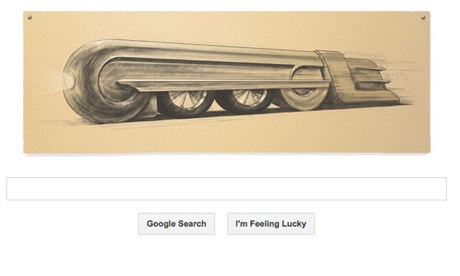
The Guardian reports:
Google's latest doodle celebrates the birthday of Raymond Loewy, the late industrial designer of the Coca-Cola bottle who was also involved in creating the Shell, Exxon, TWA and former BP logos.
Loewy's slenderised design for an S1 steam locomotive that saw service in the eastern US forms the basis of the doodle.
Described by admirers as the "father of industrial design", Loewy, who died in 1986 at the age of 92, was responsible for other notable symbols including the Lucky Strike cigarette packet.
Born in France, he emigrated to the US in 1919 after completing his engineering studies at the Université de Paris and École de Laneau.
After working in New York as a shop window decorator for Saks Fith Avenue and Macy's, he drew for Vogue, Harper's Bazaar and Vanity Fair before moving into industrial design towards the end of the 1920s.
Along with designing locomotives for the Pennsylvania Railroad Company, he was responsible for vehicles such as the Hupmobile (1934) for the Hupp Motor Company and the streamlined Greyhound buses.
CLICK HERE for more.
CLICK HERE for The Mirror's report.
World War II is the story of the 20th Century. The war officially lasted from 1939 until 1945, but the causes of the conflict and its horrible aftermath echoed for decades in both directions. While feats of bravery and technological breakthroughs still inspire awe today, the majority of the war was dominated by unimaginable misery and destruction. In the late 1930s, the global population stood at approximately 2 billion. In less than a decade, the war between the nations of the Axis Powers and the Allies resulted in some 80 million deaths -- killing off about 4 percent of the whole world.
This series of entries was published weekly on The Atlantic from June 19 through October 30, 2011, running every Sunday morning for 20 weeks. In this collection of 900 photos spread over 20 essays, I tried to explore the events of the war, the lives of the people fighting at the front and working back home, and the effects of the trauma on everyday activity. These images still give us glimpses into the experiences of our parents, grandparents and great grandparents, moments that shaped the world as it is today.
CLICK HERE to view.
*Thanks to Mr LYK for sharing.
AN EXCELLENT PRESENTATION to tell you what happened in your birth year! Very historical and true! Thanks to all who sent me this popular email forwarded post. I posted it a few years ago and am reposting it specially for those who missed it.
The Year of Your Birth
The screen is going to fade to black; have your glasses on and follow the instructions below.
You'll be pleasantly surprised with this one... Type the year only. Then click the question (?) mark.
Sit back and enjoy!
[Especially if you are a history buff... J.]
Click below...
Year of your birth
THE SCREEN WILL SCROLL BY ITSELF.
EVERYONE SHOULD SEE THIS - IT'S WONDERFUL.
This article by B. Nantha Kumar first appeared in FMT in May, 2011. I read it then but did not share it here. Mr Krishnan sent it to me recently and I feel it should be shared to remember such a brave woman. Thanks to B Nantha Kumar for writing this brilliant tribute and to Mr Krishnan for sharing.
May Malaysians be encouraged by the courage of Sybil Kathigasu.
Sybil stirs a new awakening by B Nantha Kumar
Come June 12, it will be exactly 63 years since Sybil Kathigasu, the freedom fighter, died.
Most Malaysians know little of her. This is mainly because she, along with many other distinguished non-Malay freedom fighters, have been “buried” and forgotten by the ruling Umno government.
Why this is so is another hotly debated matter.
CLICK HERE for more.
CLICK HERE to view a slide presentation on The Bridge Over theRiver Kwai Music : Malcolm Arnold
2. Kwai (Khwae Noi) - a river in western Thailand near the border with Burma, flows into the Gulf of Thailand. During the Second World War two bridges were built across the river.During the building many Allied prisoners of war were killed. The river and the events of the war was made famous by the film The Bridge on the River Kwai. The David Lean film was based on the novel by Pierre Boulle of the same title.When the Japanese entered the Second World War, they immediately began to wonderhow to avoid the blocking the Bay of Bengal by the Allies.
The search for a different way between the gained lands, stretched from Singapore to the northern border of Burma.Theydecided that the best solution would be to build a railway - linking stations in Burma and
Thailand. They marked trail through the valley of the River Kwai, although the area was almost inaccessible to man.
Work on both ends of the railway line began in June 1942. Its hard to believe that up to 60 thousand slaves were forced to work. Allied prisoners of war, later expanded the number to 200 thousand. Allied prisoners and Asian forced laborers, with the help of primitive tools, cut through three million cubic meters of rock and built nearly fifteen kilometers of bridges. When, after fifteen months the line was completed, it fully deserved to be called the "Railway of Death." The cost of lives rose to 16 thousand prisoners and 100 thousand. Asian workers.
CLICK HERE for more.
According to THIS SITE, "The Cyrus Cylinder is a 2600-year old object of modern importance, and a symbol of multi-culturalism, tolerance, diversity, and human rights. The Cylinder will visit the US for the first time in 2013 through a national tour officially sponsored by IHF America. It will be on exhibit in five major museums across the country, giving many a once-in-a-lifetime opportunity to see the iconic artifact.
The Cyrus Cylinder, which is sometimes called "the first declaration of human rights," is a barrel-shaped baked clay cylinder, about 9" long and 4" wide - smaller than an American football.
Discovered in the ruins of Babylon, the Cyrus Cylinder is from the 6th century BC, and is inscribed in Akkadian cuneiform."
CLICK HERE to read all about it.
Thanks to Angela who shared this information via email.
I do not know who is the author and hence checked the net. Eighty-six other sites have also featured this information and you can view them HERE.
Excerpt:
The Ancient Maytszishan Caves In China
Little is known about the Buddhist complex Maytszishan . It is located in Gansu Province in northwest China. This is a striking architectural complex, carved out of the rock. Maytszishan has 7,000 Buddhist sculptures and nearly 1,000 square meters of murals.
One of the earliest written records about this are found in the biographies of the two monks Tanhonga and Huanggang, who meditated there with his disciples.
CLICK HERE for more.
Here's an interesting article that Mr TSK shared via email.
Excerpt:
It leaves one speechless to learn the vast extent of things invented by the Chinese many hundreds of years, and often several millennia, before they appeared in the West.
All the myths about China and the Chinese being good at 'memorising and passing exams', but being unable to think independently or to be imaginative and creative, are just that - myths. Those stories were never true, not then and not now.
This isn't a simple matter of gunpowder and fireworks, but encompasses the entire range of human knowledge from endocrinoloy to mathematics, from agriculture to astronomy.
How could such facts have been hidden from the entire Western world for so long? And why were they withheld? Needham made his discoveries in the 1940s, but our Western education has never made reference to them, never acknowledged them.
We Westerners were taught that virtually all inventions and discoveries arose in Europe but, thanks to Joseph Needham, we have clear documentation proving they existed in China often 1,000 or more years before the Europeans copied them.
In all of the above, Needham has published not only old Chinese texts, but photos of old drawings that clearly depict all of these items, from texts that can be accurately dated. These are not wild claims or supppositions; the evidence is both conclusive and striking, and is there for anyone to examine.
Where has the world been, for so many years? How could all of this have remained hidden? How - and Why - did the West so thoroughly erase China from the world's current historical memory?
CLICK HERE for the rest of the entry.
Thanks to Angela who shared the following article taken from HERE.
Alice Kober: Unsung heroine who helped decode Linear B
By Alex Gallafent
Linear B is an ancient European Bronze Age script, dating back 3,500 years. When a British architect finally cracked it in the 1950s, he was hailed as a genius - but he may never have succeeded had it not been for a woman on the other side of the Atlantic.
For years, Linear B was seen as the Mount Everest of linguistic riddles.
First discovered on clay tablets at the palace of Knossos in Crete in 1900, it was an unknown script, writing an unknown language.
"It really was the linguistic equivalent of the locked room mystery in a detective novel," says Margalit Fox, author of a new book on Linear B, The Riddle of the Labyrinth.
How do you ever find your way into a seemingly closed system like that? A solution took more than half a century to arrive.
In 1952, a young British architect, Michael Ventris, did discover the meaning of Linear B.
Ventris was the very model of a solitary, tortured genius - so much so that the deciphering of Linear B has often been portrayed as his accomplishment alone.
But some experts now argue that Ventris would never have been able to crack the code, had it not been for an American classicist, Alice Kober.
Continue reading the main story
Discovering Knossos
The palace at Knossos was excavated by British archaeologist Arthur Evans (above) in 1900 - it's bigger than Buckingham Palace.
He discovered thousands of clay tablets inscribed with an unknown script - he called it Linear B
Evans also found tablets showing an older script, which he termed Linear A.
The importance of her contribution has only come to light now that her archives - held at the University of Texas at Austin - have been catalogued.
"Alice Kober is the great unsung heroine of the Linear B decipherment," says Fox.
CLICK HERE for more.
Duan Wu Jie, literally means “Double Fifth Festival”, is a Chinese festival celebrated on the fifth day of the fifth month based on Chinese calendar. It is celebrated today. Also known as Chinese Dumpling Festival, it is sometimes called as solar maximus festival which happens every summer solstice or the northern hemisphere’s longest day of the year. Duanwu is also often called Dragon Boat Festival since Chinese communities in many countries hold Dragon Boat race in spirit of Duanwu celebration.
Zong zi or simply zong is a traditional Chinese food popularly consumed during the Dragon Boat Festival, hence the name Chinese Dumpling Festival. Zong zi is made of glutinous rice stuffed with different fillings and wrapped in bamboo or reed leaves. They are cooked by steaming or boiling. In the Western world, they are also known as rice dumplings or Chinese tamales.
In Indonesia, Malaysia, and Singapore it’s often known as bakcang or bacang, derived from Hokkien translation of rouzong which means meat dumpling).
According to Wikipedia:
Zongzi (or simply zong) is a traditional Chinese food, made of glutinous rice stuffed with different fillings and wrapped in bamboo, reed, or other large flat leaves. They are cooked by steaming or boiling. In the Western world, they are also known as rice dumplings or sticky rice dumplings.
Zongzi (sticky rice dumplings) are traditionally eaten during the Dragon Boat Festival, which falls on the fifth day of the fifth month of the lunar calendar (approximately late-May to mid-June), commemorating the death of Qu Yuan, a famous Chinese poet from the kingdom of Chu who lived during the Warring States period.
Known for his patriotism, Qu Yuan tried unsuccessfully to warn his king and countrymen against the expansionism of their Qin neighbors. When the Qin general Bai Qi took Yingdu, the Chu capital, in 278 BC, Qu Yuan's grief was so intense that he drowned himself in the Miluo river after penning the Lament for Ying. According to legend, packets of rice were thrown into the river to prevent the fish from eating the poet's body.
Although it may have originally been a seasonal food, zongzi are available year-round in most major cities with a significant Chinese population.
Description
The shape of zongzi range from being approximately tetrahedral in southern China to an elongated cone in northern China. Wrapping a zongzi neatly is a skill that is passed down through families, as are the recipes. Making zongzi is traditionally a family event of which everyone helps out.
While traditional zongzi are wrapped in bamboo leaves, the leaves of lotus, maize, banana, canna, shell ginger and pandan leaves sometimes are used as substitutes in other countries. Each kind of leaf imparts its own unique smell and flavor to the rice.
The fillings used for zongzi vary from region to region, but the rice used is always glutinous rice (also called "sticky rice" or "sweet rice"). Depending on the region, the rice may be lightly precooked by stir-frying or soaked in water before using. In the north, fillings are mostly red bean paste and tapioca or taro. Northern style zongzi tend to be sweet and dessert-like. Southern-style zongzi, however, tend to be more savory. Fillings of Southern-style zongzi include salted duck egg, pork belly, taro, shredded pork or chicken, Chinese sausage, pork fat, and shiitake mushrooms.

Zongzi need to be steamed or boiled for several hours depending on how the rice is made prior to being added, along with the fillings. However, as the modes of zongzi styles have traveled and become mixed, today one can find all kinds of zongzi at traditional markets, and their types are not confined to which side of the Yellow River they originated from.
- Jianshui zongzi without fillings
- Mung beans, split and dehulled
- Red bean paste
- Jujubes
- Char siu (Chinese barbecued pork)
- Chinese sausage
- Salted pork fat
- Chinese black mushrooms
- Salted duck eggs
- Chestnuts
- Cooked peanuts
- Conpoy (dried scallops)
- Red-cooked pork
- Chicken
CLICK HERE for more on variations of rice dumplings.